Calling-code catalog
Country calling code lookup
Search calling-code records by code, region, or label without entering a phone number.
- No phone-number input
- One record with a one-to-many regions list
- Browser-local catalog search
Try it now
Search country calling codes
Search the packaged calling-code catalog by code, region, or label. No phone number is needed.
0 calling-code records shown.
No matching calling-code records.
Quick answer
Search calling-code relationships
Each calling code has one catalog record with a regions list or a non-geographic service label.
Search
Use a code, region, or label.
Shared plans
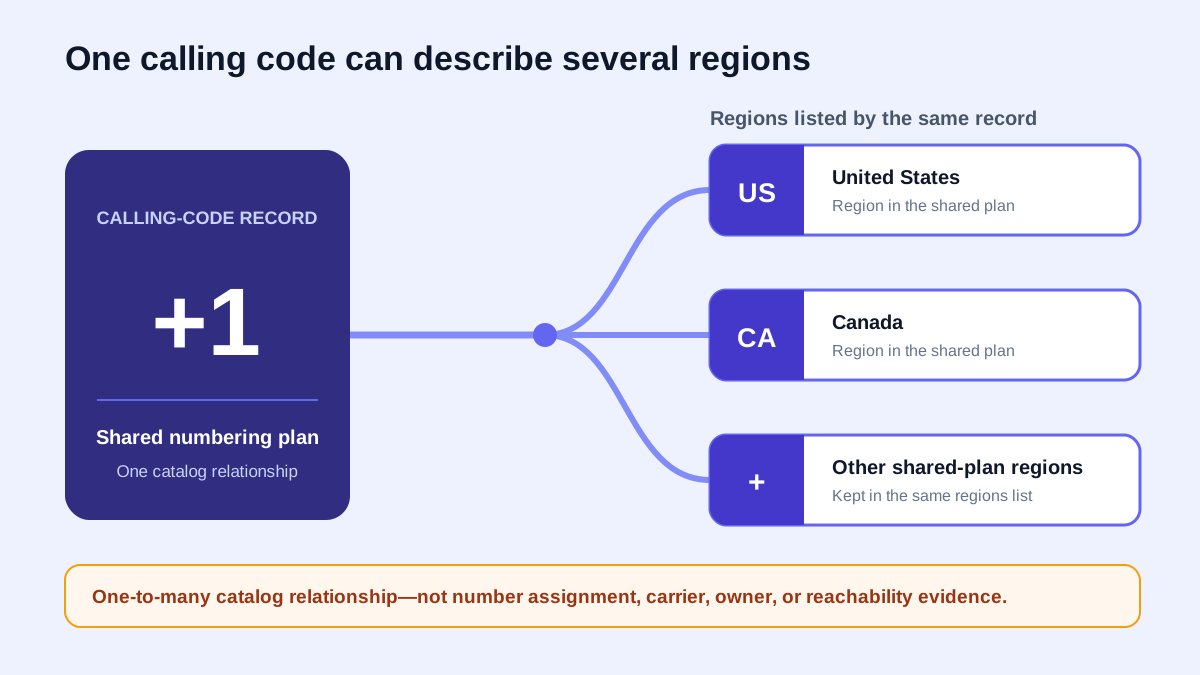
One record can list many regions.
Boundary
A code does not assign a number.
Practical workflow
Search the catalog
Type a code or name and inspect the matching calling-code record.
- 1
Search
Enter a code or label.
- 2
Inspect
Review its regions list.
- 3
Use carefully
Confirm destination requirements elsewhere.
What a calling code does not show
Catalog relationships do not establish assignment, carrier, owner, reachability, or deliverability.
One record per calling code
The catalog represents one calling-code record at a time. A record can list multiple regions where a shared numbering plan uses the same code, rather than pretending that every code belongs to exactly one country.
Some calling codes describe non-geographic services. Those records are kept visible because a code relationship alone is not a statement about a physical location.
How to search without overinterpreting results
Search by digits, a region abbreviation, or a visible label. The result is a reference to calling-code relationships, not a parser for the ownership or routing of a phone number.
A listed region does not prove that a particular number was issued there or that a call, message, or registration will succeed.
When to use another tool
Use this page to look up code relationships without entering a phone number. Use the national display or RFC3966 formatter only when you have one global number and want that specific representation.
For an origin-sensitive default dialing representation, use the dialing-format tool. It can return a typed unavailable result rather than supplying an invented route.
Practice resource
Shared calling-code plans
Geographic and shared-plan relationships use packaged libphonenumber-js@1.13.9/max metadata with pinned ITU-T E.164 (02/2026), Operational Bulletin 1341 (2026-06-01). The checked-in +800 non-geographic service record comes from that ITU source. The catalog was checked 2026-07-20 and is not live assignment or reachability data.
| Query | Record | Meaning |
|---|---|---|
| GB | +44; GB, GG, IM, JE | Shared plan |
| 7 | +7; KZ, RU | Shared plan |
| 800 | +800; no geographic region | International Freephone Service |
Catalog result
A calling-code record includes its regions list.
| Input | Result | Meaning |
|---|---|---|
GB | +44 — United Kingdom / Guernsey / Isle of Man / Jersey; shared-plan; Regions: GB, GG, IM, JE | Exact packaged catalog record. |
7 | +7 — Kazakhstan / Russia; shared-plan; Regions: KZ, RU | One calling code can cover multiple regions. |
800 | +800 — International Freephone Service; non-geographic; Regions: No geographic region | Checked-in pinned ITU service record, not an owner lookup. |
Calling-code catalog questions
Do I need to paste a phone number?
No. This page only searches the catalog.
Does one code always mean one country?
No. Shared plans can list several regions, and some records are non-geographic.
Does a result identify an owner or carrier?
No. It only describes packaged calling-code relationships.
Policies and references
Related phone converters and workflows
Continue with the next workflow or browse the full directory.